
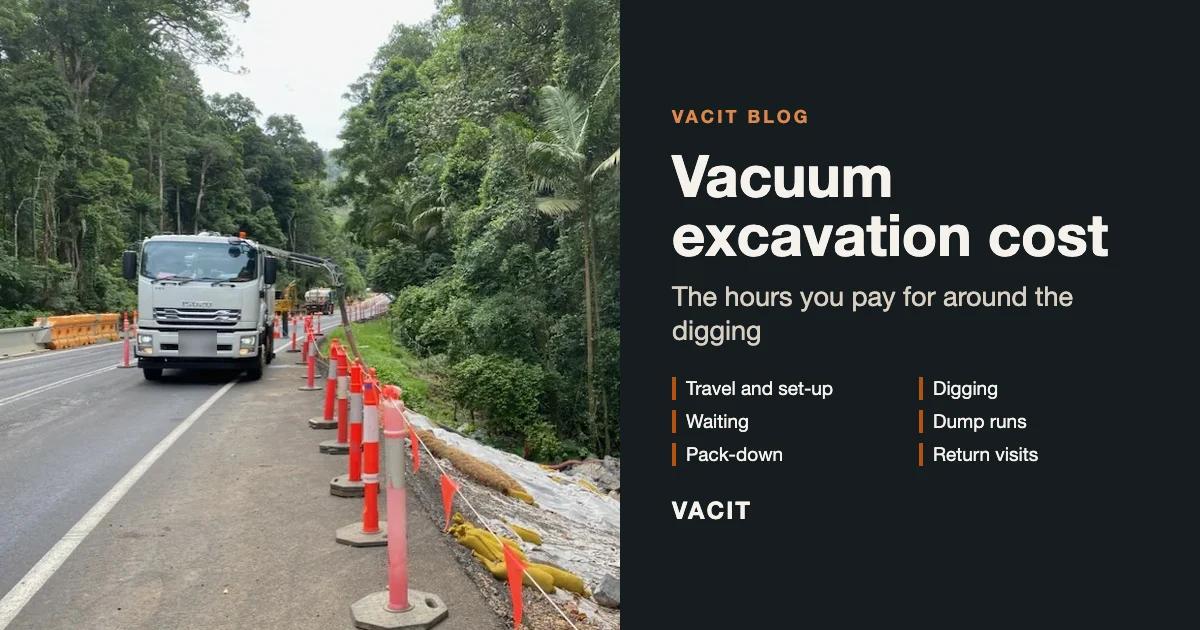
Pricing a job that needs services exposed, or comparing two vac truck quotes? The hourly rate is the number everyone looks at first. On most jobs it is not what decides the total. The total comes from how many hours the truck and crew are tied up, and many of those hours happen before or after the digging.
The short answer
Vacuum excavation cost is the rate multiplied by every hour the truck and crew are committed to your job. Add any separate charges for disposal or water. Those hours include travel, set-up, digging, waiting on site, trips to empty the tank, pack-down and any return visit.
This guide does not give dollar figures. Rates change with truck size, crew, location and the work, so a published number would mislead more readers than it helps. It shows where the hours go, which of them you control, and what to send so a quote reflects the real job.
Listen to this article
The full article, read aloud(13 min)
The transcript below follows the audio.
Read the transcript
Key takeaways
- The hourly rate is one line. The bill is driven by total committed hours, so a cheaper rate with more hours can cost more.
- Six blocks of time make up a typical job: travel and set-up, digging, waiting, dump runs, pack-down and return visits.
- Waiting and return visits are the hours a client controls most. Plans, permits, traffic control and site access sorted before the booking keep them low.
- Spoil (the soil the truck removes) has to go somewhere, and where it goes matters. Queensland's waste levy applies to waste disposed to landfill, and no levy is charged on recycled material.
- Compare quotes on the same scope. Ask each provider how they charge minimums, travel, water, disposal and waiting time.
Why the hourly rate is only one line on the bill
Search results for "how much does vacuum excavation cost" mostly answer with an hourly or daily rate. That is useful for a rough budget. It is not enough to compare two quotes or to price a job you have to stand behind.
Some jobs are charged on time rather than on the volume of soil moved. Then the total depends on how long the truck and crew are committed to you. A truck that spends half its day driving to a tip, waiting for a traffic crew or coming back next week is still on your job. A tip is a disposal site.
Two quotes with the same rate can land a long way apart. Two quotes with different rates can land in the same place. The difference sits in the hours around the digging, and in how each provider treats them.
The six blocks of time on a vacuum excavation job
Every job breaks down into the same blocks, whatever the rate. The table shows what happens in each block, what makes it longer and what you can send to keep it in check.
| Block of time | What happens | What makes it longer | What you can send |
|---|---|---|---|
| Travel and set-up | The truck drives to site, parks, runs out hoses and sets up exclusion zones | Distance, tight access, long hose runs, no clear parking spot | Site address, truck access, parking position and estimated hose distance |
| Digging | The crew loosens and removes soil to expose services or dig to depth | Hard or wet ground, depth, number of holes, services close together | Required depth, pothole count, ground conditions, plans and marks |
| Waiting | The crew is on site but cannot dig | Permits not in place, traffic control late, area not handed over, services not located | Timing, site controls, permit status, who else is on site |
| Dump runs | The truck leaves to empty its tank and comes back | Small tank for the volume, wet slurry, a distant tip, no water on site | Material, volume, water access, disposal requirements |
| Pack-down | Hoses are rinsed and stowed, the site is left safe | Long hose runs, difficult access | Access notes and photos |
| Return visits | A second mobilisation for work that could not be done | Missing information, wrong truck for the access, the next trade not ready | All of the above, plus the trade or activity that follows |
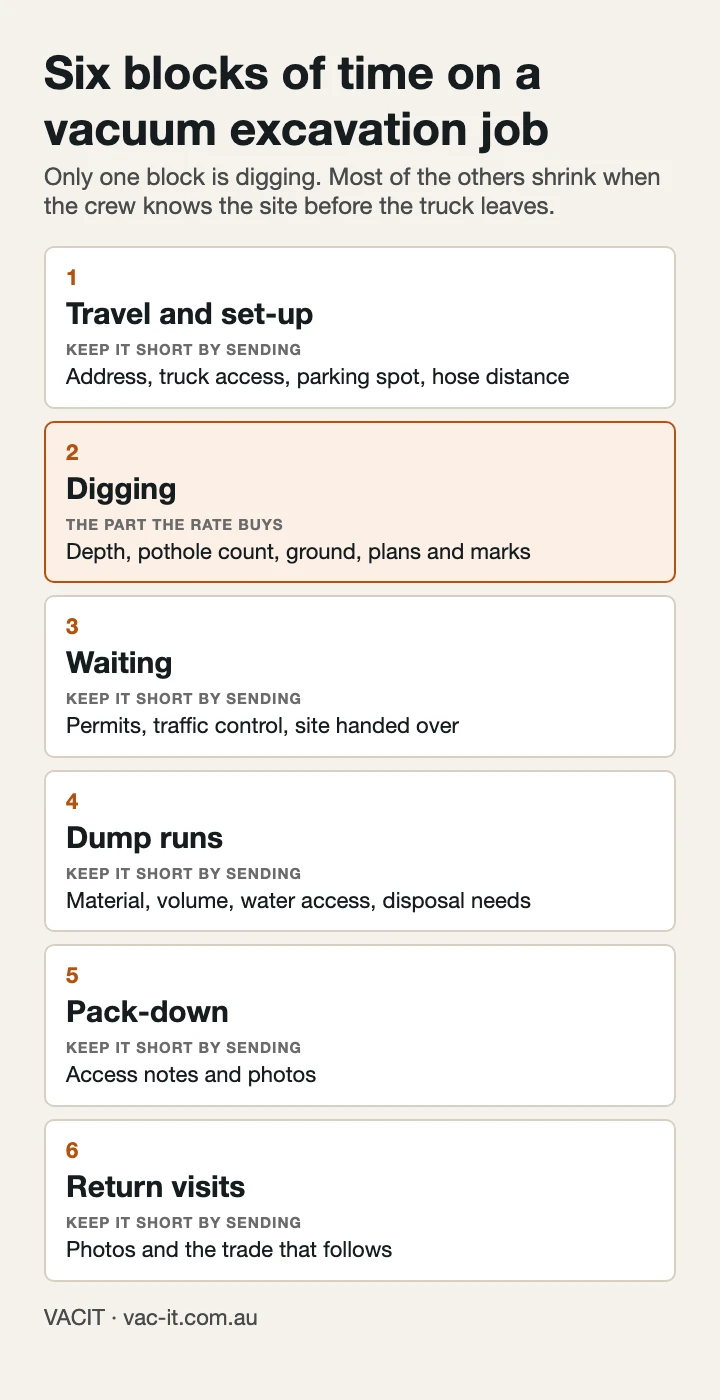
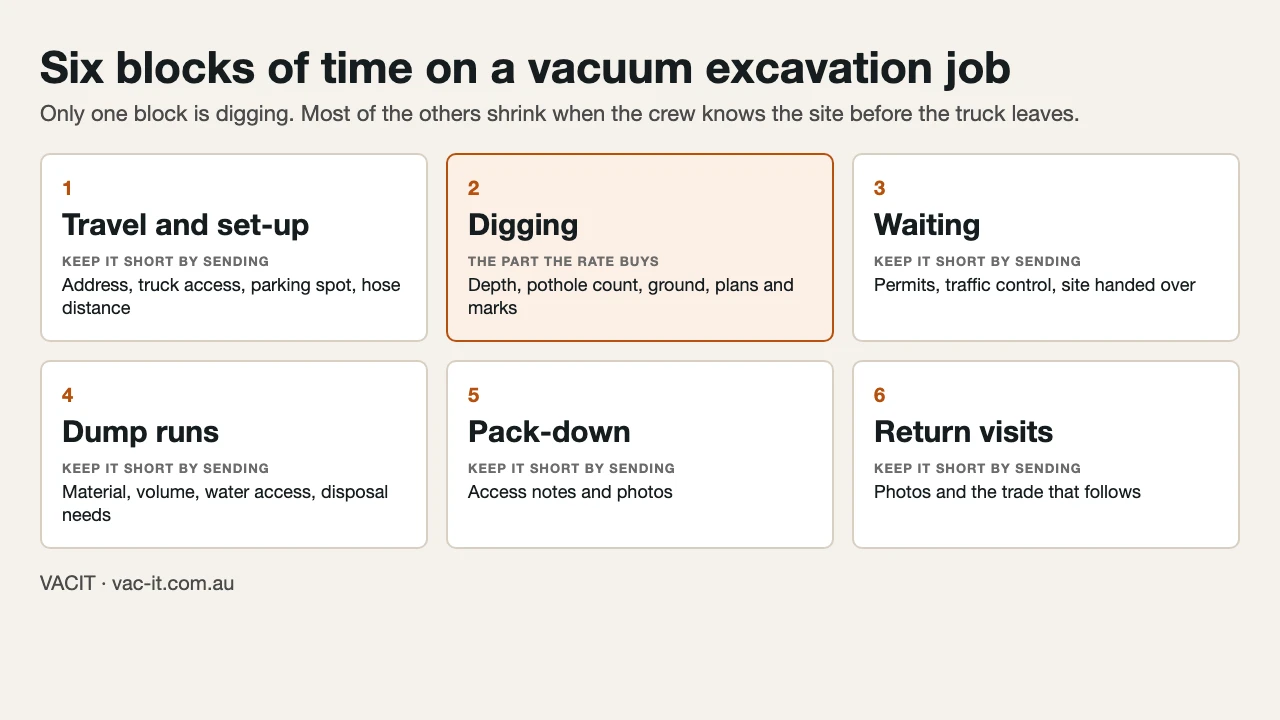
Only one block is the digging you asked for. The others are part of doing it properly, and most of them shrink when the provider knows the site before the truck leaves the yard.
Travel and set-up: where the truck can park decides a lot
Before any soil moves, the truck has to reach the site and get into a position where its hose can reach the work. On an open civil site that can be quick. On a tight commercial lot, a footpath or a busy road reserve it takes longer.
Hose distance matters because suction drops the further the hose runs from the truck. A long run can mean slower digging, a different truck or a second set-up. That is why our quote page asks for access and an estimated hose distance, and why our vacuum excavation page lists both as quote inputs.
Truck choice follows from access. VACIT runs nine vacuum trucks from 5,000 to 10,000 litres, including compact trucks for tight access and larger units for heavier excavation and loading. The right one depends on where it can stand and how much it needs to carry.
Ask any provider whether travel is charged from their yard, charged only beyond a set distance, or built into the rate. Answers differ, and the difference shows up on a job outside the city.
Digging time: ground, depth and how many holes
Digging time is the part the rate was meant to buy. It still varies a lot. Hard clay, rock, wet ground, depth and the number of potholes (small holes dug to expose a service) all change how long it takes. So does how close services sit to each other, because the crew slows down near them.
It also depends on what you already know. Before You Dig Australia (BYDA) plans are free to request, but they show the presence of infrastructure, not its exact location. Our article on whether Dial Before You Dig is free covers what happens after you lodge an enquiry.
If services have been located and marked first, the crew can dig to confirm them rather than search for them. Where that work is needed, underground service locating before excavation can save truck time spent searching. Our article on the Excavation Work Code of Practice covers what it expects before digging near services.
Send the required depth, the number of holes, the ground conditions you expect, and any plans or marks. A photo of the surface helps too, because concrete, asphalt or turf each change the first part of the job.
Waiting time: permits, traffic control and an unready site
On a waiting block, the truck and crew are on site, booked and ready, but they cannot start or cannot keep going. It is also the block a client can control best.
The usual causes are practical. The traffic control crew is late or has the wrong plan. A permit has not come through. The work area has not been handed over. Services have not been located. Or the trade that follows is not ready, so the holes cannot be backfilled or handed on.
Permits take time. Work on a state-controlled road needs permission from the Department of Transport and Main Roads (TMR) to occupy the road. It also needs a traffic control permit, lodged by a registered traffic management company. TMR asks applicants to allow at least 10 business days for processing. Council roads have their own process, so check with the relevant council. Traffic control can also be a separate cost when a traffic management company is engaged, so check whether it is inside or outside each quote.
Ask each provider how standby time is charged. Then send the work window, the site controls, the permit status and who else will be on site. Booking after the permit and traffic control are confirmed avoids paying for a crew that cannot start.
Dump runs: tank size, water and where the spoil goes
Every vac truck has a tank. When it is full, the truck leaves to empty it and comes back. Each round trip is time on your job.
Three things decide how many trips there are. First, the volume: loosened soil takes up more room than it did in the ground. Second, the water: hydro excavation is vacuum excavation that uses water to loosen the soil, so the tank fills with slurry rather than dry spoil. Our guide to vacuum excavation vs hydro excavation explains how the two relate. Third, the distance to a tip or other site that will accept the material.
Truck size helps here, but only if the truck can reach the work. A larger tank means fewer trips on an open site. On a tight site a smaller truck that can park close may finish sooner. Water access matters too, because a hydro truck has to refill as well as empty.
Where the spoil goes also changes the cost. The Queensland Government says its waste levy "is applied to all waste that is disposed to landfill." It adds: "If materials are recycled, there is no levy charged." The rate also depends on where the waste is generated and where it is disposed.
Some material is regulated waste. For trackable waste, Business Queensland says the waste generator must give the transporter the prescribed information, and keep it for at least five years. Tell your provider about any known contamination before the job, not when the truck reaches the tip.
Ask how disposal is charged: included, per load, per tonne or passed on at cost. Then send the material, the expected volume and any disposal requirements you already know.
Return visits: the hours you pay for twice
A second mobilisation (the truck and crew coming back) repeats travel and set-up, and often some pack-down, for work that one visit could have covered.
The causes are usually information gaps. The truck could not reach the work. The ground was harder or deeper than described. A service was not where the plan showed and the area was not located. Or the next trade was not ready, so the job was split.
Photos of the work area and the access route prevent many of these. So does telling the provider what follows the excavation, whether that is boring, a footing, a pit or reinstatement. With that information the crew can plan to finish the stage in one visit.
How to compare two vacuum excavation quotes
When you compare vacuum truck services, the total depends on more than the rate. Comparing rates alone rewards the quote that leaves the most out, so put each quote against the same questions.
| Question to ask | Why it changes the total |
|---|---|
| Is there a minimum charge, and how many hours does it cover? | A short job can cost the same as a longer one |
| Is travel charged from the yard, beyond a set distance, or included? | Changes the cost of jobs outside the city |
| Are night, weekend or after-hours work windows charged differently? | Some sites only allow work at set hours |
| Is traffic control included, or priced separately? | It can be a separate invoice from the truck |
| How is waiting or standby time charged? | Decides who pays when the site is not ready |
| Is disposal included, per load, per tonne or passed on? | Two quotes can treat it very differently |
| Is water included for hydro excavation, and where will the truck refill? | Affects both cost and dump runs |
| Which truck is quoted, and can it reach the work? | The wrong truck for the access can mean a return visit |
| What scope is included: depth, pothole count, reinstatement? | Two quotes may not be for the same job |
Ask for each answer in writing. Then compare the totals for the same scope, not the rates.
What to send for an accurate quote
The more the provider knows before the truck leaves, the fewer hours you pay for that are not digging. Our vacuum excavation and hydro excavation pages list what we ask for:
- Site address, service area and preferred timing or work window
- Truck access, parking position and estimated hose distance
- BYDA plans, on-site marks or known asset information
- Required depth, pothole count and excavation area
- Ground conditions, material and known hazards
- Water access and site controls
- Material volume, slurry volume and disposal requirements
- Photos of the work and access areas
- The trade or activity that follows exposure
We use those details to match the truck and crew to the job. You can also put the comparison questions above to us when you send them.
You can send all of this through REQUEST A QUOTE, or call us on 0439 761 096 to talk it through.
General information only
This article is general information, not legal, engineering or safety advice. Check current permit, waste and safety requirements with the Department of Transport and Main Roads, your local council, the Queensland Government's waste pages and WorkSafe Queensland. Sources were checked on 10 November 2026.
Vacuum and hydro excavation across SEQ
Want a quote that matches the real job?
Send the site address, timing, truck access and hose distance, plans or marks, depth and pothole count, material, water access, disposal needs and photos.
VACIT ON GOOGLEFrequently asked questions
How much does vacuum excavation cost per hour?
Hourly rates vary with truck size, crew size, location and the work, so this guide gives no figure. The rate is also only part of the total. Ask for a quote on your actual scope, and compare totals rather than rates.
Does hydro excavation cost more than vacuum excavation?
Hydro excavation is vacuum excavation that uses water to loosen the ground, so its cost follows the same hours. Water supply, refills and slurry volume become part of the job, and they can add dump runs. Whether water is the right way to loosen the ground depends on the soil, the services and the site.
What should I ask about a minimum charge?
Travel, set-up and pack-down take time even on a short job, so some quotes include a minimum charge. If yours does, ask how many hours it covers and what is included before you book a small job.
Who pays for disposal of the spoil?
That depends on the quote. Disposal may be included, charged per load or per tonne, or passed on. In Queensland the waste levy applies to waste disposed to landfill, and no levy is charged on recycled material.
How can I keep the cost of a vacuum excavation job down?
Have plans, located services, permits and traffic control in place before the booking. Send photos, access and hose distance, depth, material and disposal needs. Make sure the next trade is ready, so the job is finished in one visit.
Related Posts
Excavation Work Code of Practice: Using the Queensland Version
Which excavation work code of practice applies on a Queensland site, what it asks before digging near underground services, and what to keep on file.
Is Dial Before You Dig Free? What BYDA Plans Cover
Lodging a Before You Dig Australia enquiry is free. Here is what the free plans cover, what they leave out, and what a Queensland site still needs.
Vacuum Excavation vs Hydro Excavation
Hydro excavation is a type of vacuum excavation, not a rival method. Here is what the terms actually mean, what Queensland rules expect first, and what to send with an enquiry.
Vacuum Excavation Truck: What a Civil Site Enquiry Needs
A guide for civil site supervisors preparing a vacuum excavation truck enquiry. It covers how VACIT's water-and-vacuum method works, how plans differ from physical exposure, and a matrix showing what you can supply and what VACIT confirms for the job.