Writing a safe work method statement (SWMS), a prequalification pack or a dig plan near services in South East Queensland? Cite Queensland's own code. Search for "excavation work code of practice" and you will also find another state's code, a national model edition, a 2015 copy and company rules. They look alike. Only one is approved for Queensland.
The short answer
Use the Excavation Work Code of Practice 2021, published by Workplace Health and Safety Queensland (WorkSafe Queensland). The current Queensland notice of approved codes lists it, commencing 1 March 2021 (Work Health and Safety (Codes of Practice) Notice 2022).
Before digging near underground services, the person in control of the site must take all reasonable steps to get current information about those services. They must pass it to the crew doing the excavation and keep it available. The code adds that this information may not be accurate. So the dig should start with a check, such as exposing a short section of the service.
Listen to this article
Listen to the full article(13 min)
The transcript below follows the audio.
Read the transcript
Key takeaways
- The Queensland document is the Excavation Work Code of Practice 2021. Interstate codes, model editions and company procedures are not substitutes for it.
- Queensland's WHS Act requires a business to follow an approved code, or manage the risk another way that gives an equivalent or higher standard.
- Before excavation starts, the person in control of the workplace must take all reasonable steps to get current services information, including location and depth.
- Plans show approximate locations only. The code recommends an initial examination, such as potholing with water pressure and a vacuum system, to confirm where a service is.
- Keep the services information until the job is finished, or for at least two years after a notifiable incident.
Which excavation code applies on a Queensland site?
The Excavation Work Code of Practice 2021 is the approved code for excavation work in Queensland. It sits in Schedule 1 of the Work Health and Safety (Codes of Practice) Notice 2022, in force from 1 March 2021. The Excavation Work Code of Practice 2021 PDF runs to 62 pages on WorkSafe Queensland's website.
In Queensland, an approved code is more than background reading. Section 26A of the Work Health and Safety Act 2011 (Qld) gives a business two choices. It can comply with the code. Or it can manage the risks in a different way that "provides a standard of health and safety that is equivalent to or higher than the standard required under the code."
Section 275 lets a court treat an approved code as evidence of what is known about a hazard and how to control it.
The notice also says codes in this part of the schedule must be reviewed at least every five years. The 2021 code reached that point in 2026. On 5 November 2026 the notice still listed it, so check again before you finalise a long-running document.
How to check the copy in your SWMS is the right one
The quickest way to catch the wrong document is to read its front pages, not the search result. Five questions sort it out.
| Check | What the Queensland code shows | Warning sign |
|---|---|---|
| Who issued it? | Workplace Health and Safety Queensland, downloaded from worksafe.qld.gov.au | Another state's regulator on the cover, or a company or university logo |
| Which jurisdiction? | Queensland: approved under section 274 of the Work Health and Safety Act 2011 (Qld) and listed in the Queensland notice | Approval by another state, or no approval at all |
| Which edition? | "Excavation work Code of Practice 2021" on the cover | A 2013 or 2015 date, or an undated copy |
| Is it in the current approved list? | Listed in Schedule 1 of the Codes of Practice Notice 2022 | Not in the notice, or you cannot find where it came from |
| Is it a code or a procedure? | A code of practice: a practical guide to meeting the WHS Act and Regulation | A "standard", "procedure" or "requirement" written by one organisation for its own sites |
The licence line inside the Queensland PDF credits Safe Work Australia, because the code is adapted from the national model. That is expected. The Queensland cover and its approval under section 274 are what make it Queensland's code.
The 2021 code still tells readers to contact "Dial Before You Dig" by phoning 1100 or through 1100.com.au. The service now operates as Before You Dig Australia (BYDA). Enquiries are lodged free through the BYDA website or app (BYDA FAQs). If your SWMS copied the code's contact wording, update that line. Only the contact details have changed.
What the code expects before you dig near underground services
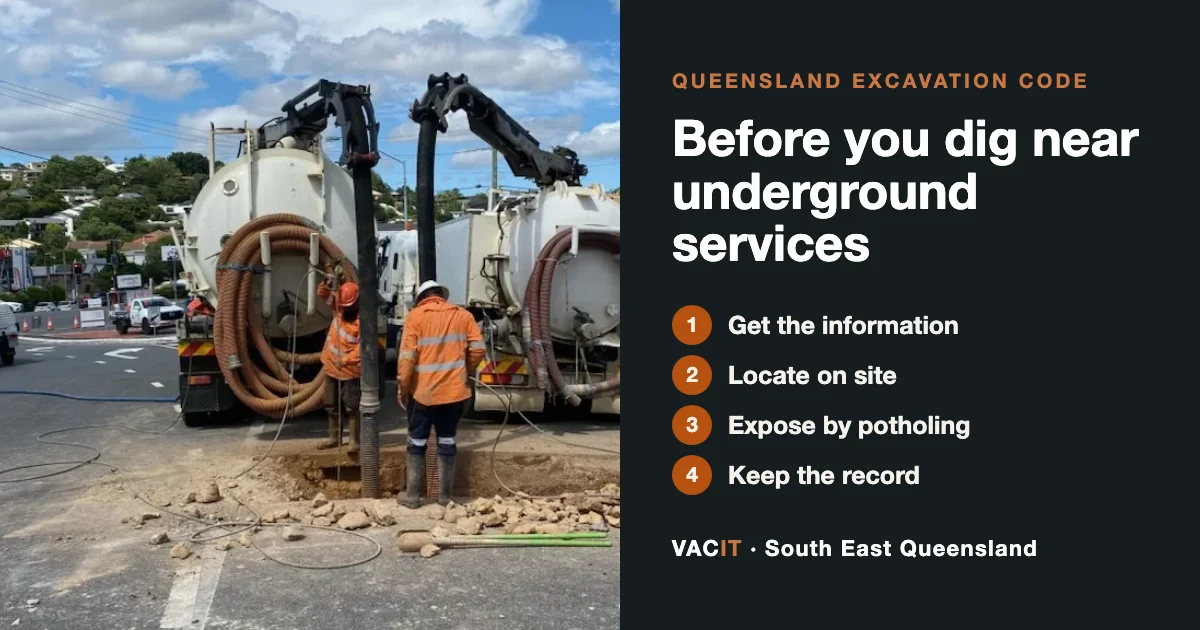
The regulation makes getting the services information a legal duty. The code then recommends locating the services and checking them by exposure. Section 304 of the Work Health and Safety Regulation 2011 (Qld) sets out the information duty. Section 3.6 of the code explains how to act on it, in four steps.
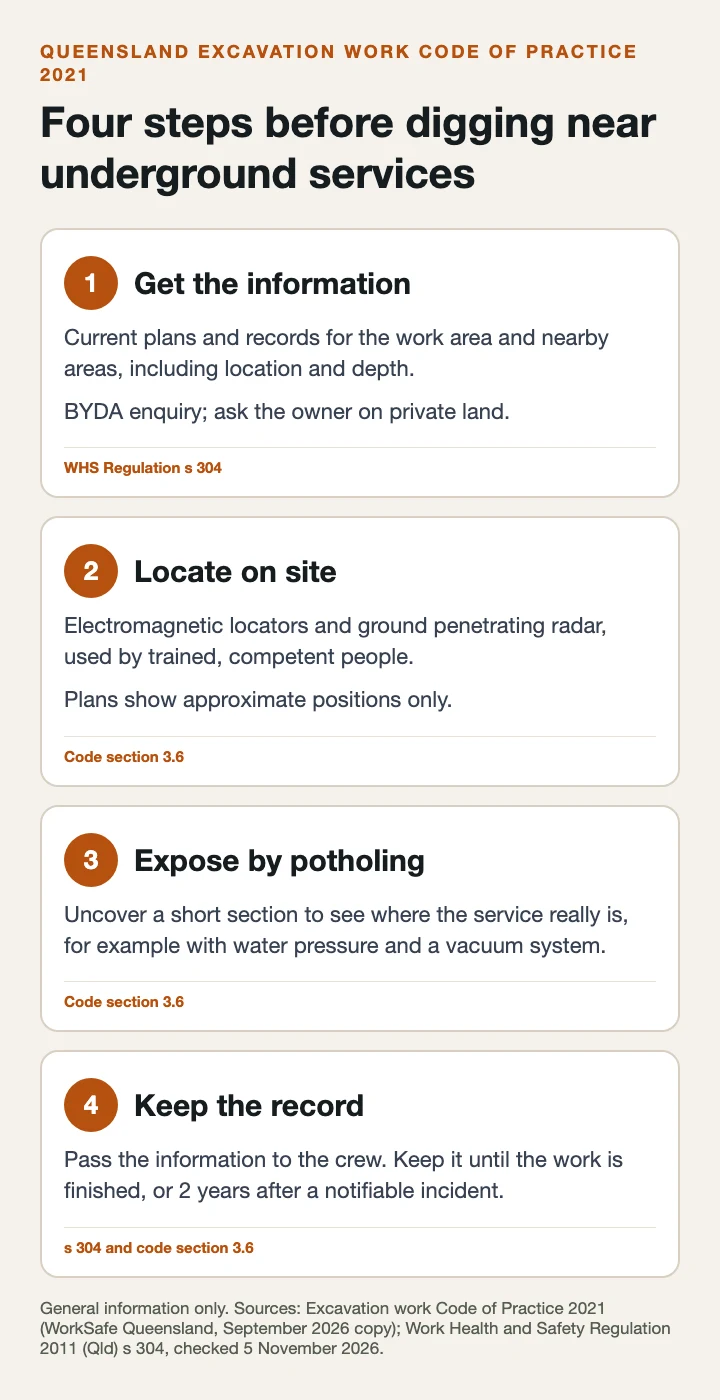
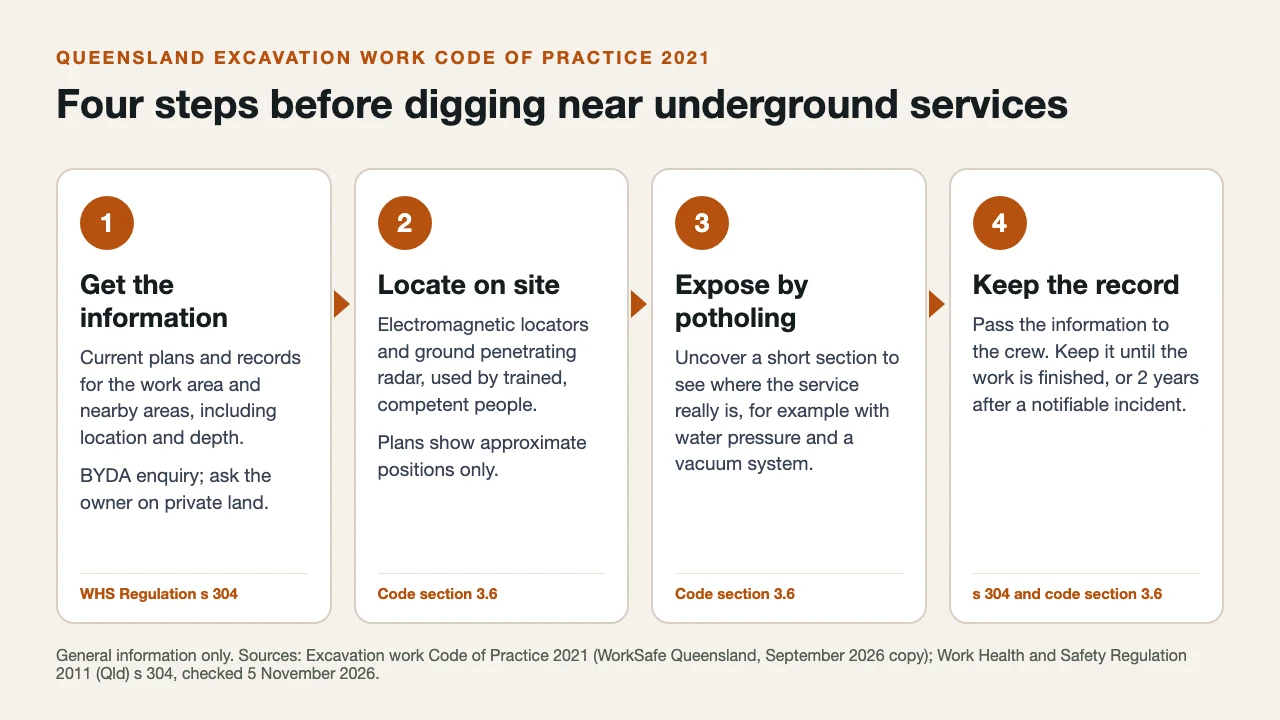
1. Get current information. Before directing or allowing excavation to start, the person in control must "take all reasonable steps to obtain current underground essential services information" (section 304). That covers the work area and adjacent areas.
The regulation defines that information as the services that may be affected, their location "including the depth", and any conditions on the work. A BYDA enquiry is the usual starting point; see what BYDA plans show and what they leave out. On private property, the code also says to ask the owner or occupier about buried cables.
2. Locate the services on site. BYDA says the plans that asset owners supply show an "approximate location" and do "not pinpoint the exact location". It also says it is important "never to assume the depth or alignment of pipes and cables" (BYDA FAQs).
The code names electromagnetic cable locators and ground penetrating radar as ways to find services. It says the workers using that equipment must have the relevant training and be competent in its use. That is the job of on-site locating of underground services.
3. Expose the service where certainty matters. The code's wording is direct: "Available information about existing underground essential services may not be accurate." It says excavation methods should include an initial examination, "for example sampling the area by exposing a short section of underground services usually using water pressure and a vacuum system".
This is potholing, explained in our guide to potholing to confirm a service's position. Queensland's Electrical Safety Office made the same point in February 2022, after a run of cable contacts. It said plans and electronic locating "cannot be relied upon for physical service locations" (Hidden risks of underground cables, archived copy).
4. Keep the record. The services information must be made available to workers, the principal contractor and subcontractors, and kept for inspection (more on this below).
Before You Dig Australia has a short explainer on its process and its "5Ps": plan, prepare, pothole, protect and proceed. It is industry guidance rather than law, and it follows a similar order to the code.
Who holds the duty when you bring in a locator and a dig crew?
The duty to get the services information sits with the person with management or control of the workplace. On a construction project, that is often the principal contractor. The regulation defines a construction project as construction work costing $250,000 or more. It has one principal contractor at a time (sections 292 and 293).
Section 304 then passes the information down the line. The person in control "must provide the information" to anyone they engage to do the excavation work. Both that person and the business that receives it must have regard to it.
In practice, the plans and locate results should reach the excavation crew and the plant operator, not stay in the site office. The code says subcontractors and plant operators should be given the services information too.
Engaging a locator or a vacuum excavation crew does not transfer your duty to them. Under the WHS Act a duty cannot be transferred (section 14), and more than one business can hold the same duty at once (section 16).
Does the principal contractor's procedure replace the code?
No. A principal contractor's procedure usually sits on top of the code. Many large contractors write their own excavation standard, and some add steps the code does not spell out, such as a permit to dig.
What a procedure cannot do is replace the code with a lower standard. Section 26A of the Act allows a different method only if it gives an equivalent or higher standard of health and safety. When a company rule and the code point different ways, ask the principal contractor how they want the difference handled. Record the answer in your SWMS. Where it is still unclear, work to the stricter requirement.
What to keep on file
The services information must be available for inspection until the excavation work is completed. If a notifiable incident occurs, it must be kept for at least two years after it (section 304).
The code also says a SWMS must be prepared for managing the risks of excavation work involving underground services. Under section 291 of the regulation, high risk construction work includes work in or near a trench deeper than 1.5 metres. It also includes work on or near pressurised gas distribution mains or piping, chemical, fuel or refrigerant lines, and energised electrical installations or services. Work in an area with moving powered mobile plant is on the list too.
| Step | What the code or regulation asks | What to keep on file |
|---|---|---|
| Get the information | Take all reasonable steps to obtain current services information, including location and depth (s 304) | BYDA plans and enquiry confirmation, owner or occupier information for private property, the date you obtained them |
| Pass it on | Provide it to anyone engaged to do the excavation (s 304) | Who received the plans, and when |
| Locate on site | Use locators operated by trained, competent workers (code 3.6) | The locate results and marks, the method used, who did it |
| Expose where needed | Initial examination, for example potholing with water pressure and vacuum (code 3.6) | Where services were exposed, what was found, photos |
| Plan the work | SWMS for excavation involving underground services (code 3.6; s 291) | The SWMS, the version of the code it cites, and any principal contractor procedure it follows |
Need to hand the results to a designer or another contractor? Recording located services on a site plan turns them into a document the next person can use.
General information only
This article is general information, not legal or safety advice. Check the current code and regulation with WorkSafe Queensland, and follow your principal contractor's requirements and any asset owner's conditions. Queensland legislation and the approved-codes notice were checked on 5 November 2026. The WorkSafe Queensland code PDF and BYDA's FAQs were checked against their September 2026 copies.
When the plans and the locate leave doubt
The step that confirms where a service really sits is exposure, and that is our work. VACIT provides underground service locating, utility mapping and non-destructive exposure with vacuum excavation across Brisbane, the Gold Coast and South East Queensland.
VACIT is a NULCA locator member and is listed in the CERTLOC directory as a Certified Locating Organisation.
To get the job quoted properly, send the site address, plans and known assets, hazards and site controls, photos, access and hose distance, and timing. You can request a quote with your site plans and known assets, or call us on 0439 761 096.
Locating and exposure across SEQ
Need services located or exposed before you dig?
Send the site address, plans and known assets, hazards and site controls, photos, access and hose distance, and timing.
VACIT ON GOOGLEFrequently asked questions
Is the excavation work code of practice legally binding in Queensland?
In practice, yes, for the standard it sets. A code of practice is not a regulation, but section 26A of the WHS Act requires a business to comply with an approved code. The alternative is to manage the risks in a way that gives an equivalent or higher standard. A court can also use the code as evidence of what was reasonably practicable.
Do BYDA plans tell me how deep a service is?
No. BYDA says plans are indicative only and that you should never assume the depth or alignment of pipes and cables. The regulation asks for location including depth, which is why on-site locating and potholing follow the plans.
Do I need a SWMS to dig near underground services?
The code says a SWMS must be prepared for managing the risks of excavation work involving underground services. Under the regulation, high risk construction work needs a SWMS before it starts. The list includes work in or near a trench deeper than 1.5 metres, and work in an area with moving powered mobile plant. It also includes work on or near pressurised gas distribution mains or piping, chemical, fuel or refrigerant lines, or energised electrical services.
What does a service locator do?
A locator uses equipment such as electromagnetic cable locators and ground penetrating radar to find and mark underground services on site. The code says the people operating that equipment must have the relevant training and be competent. Locating gives a likely position; exposing the service confirms it.
Does the code say I have to use vacuum excavation?
No. The code gives potholing with water pressure and a vacuum system as an example of an initial examination. It also describes potholing with hand tools, including insulated tools suited to the voltage. Choose the method that suits the service, the ground and the site.
Related Posts
Is Dial Before You Dig Free? What BYDA Plans Cover
Lodging a Before You Dig Australia enquiry is free. Here is what the free plans cover, what they leave out, and what a Queensland site still needs.
Vacuum Excavation vs Hydro Excavation
Hydro excavation is a type of vacuum excavation, not a rival method. Here is what the terms actually mean, what Queensland rules expect first, and what to send with an enquiry.
Vacuum Excavation Truck: What a Civil Site Enquiry Needs
A guide for civil site supervisors preparing a vacuum excavation truck enquiry. It covers how VACIT's water-and-vacuum method works, how plans differ from physical exposure, and a matrix showing what you can supply and what VACIT confirms for the job.
Commercial Stormwater Pit Cleaning: Warning Signs
A practical commercial guide to visible stormwater-pit warning signs, what information to gather, and when to organise drain cleaning and vacuum support.