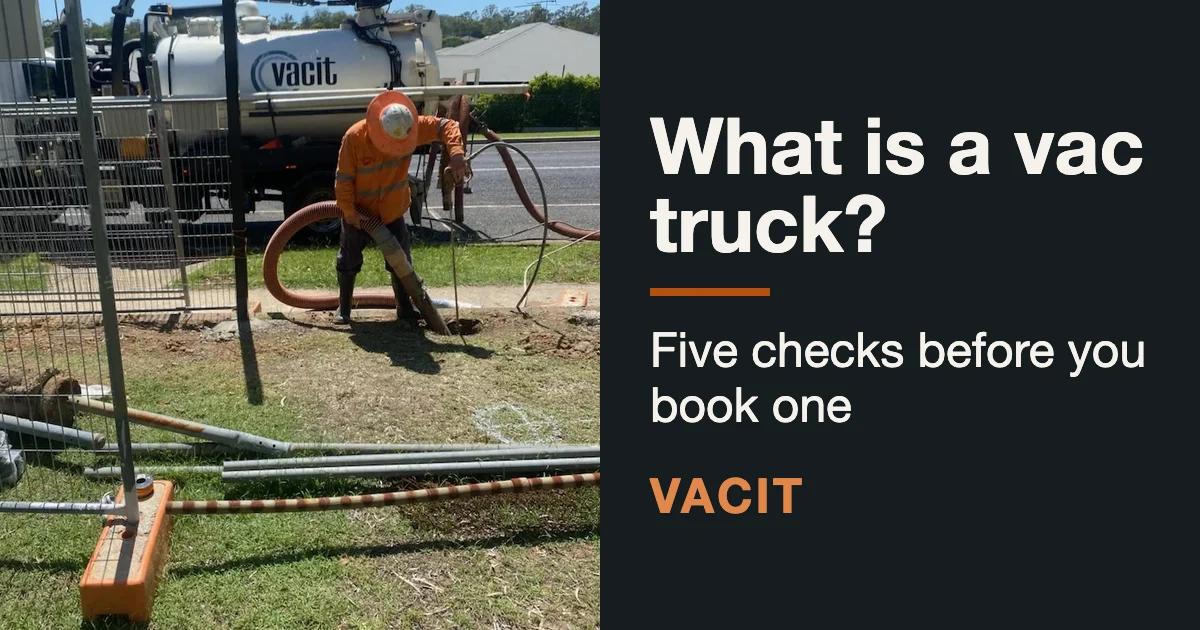
Someone on site has said "we'll need a vac truck for that", and now it's your job to book one. Maybe it's a blocked stormwater pit, a pipe that has to be found before a wall goes in, or a trench near live services. A vac truck is a truck with a vacuum system, a sealed tank and a suction hose, run by a crew. This guide explains what it does and how to tell whether your job is ready for one.
The short answer
The crew uses a vac truck to lift soil, slurry and other wet material from the ground, pits, tanks and drains, without a digger bucket.
On most digging work around underground services, water loosens the ground and the vacuum lifts the wet soil, called slurry, into the tank. VACIT's nine trucks have debris tanks from 5,000 to 10,000 litres.
The truck is the easy part. Five things make a job ready to book: what's in the ground, where the truck parks, what's coming out, where it goes and what's next.
Key takeaways
- You book the truck and its crew, not a machine on its own.
- A vac truck does two main jobs: exposing buried pipes and cables, and loading wet material out of pits, tanks and drains.
- Queensland's excavation code says information about underground services "may not be accurate". Get plans and have services located before the truck digs.
- Where the truck parks and how far the hose has to run decide which truck suits your site.
- Know the material, the amount and where the spoil (the dug-out soil and slurry) goes before the crew arrives.
What a vac truck is
Strip away the paint and a vac truck has three working parts. A vacuum pump or blower pulls air out of a sealed tank. The low pressure in the tank draws material up a wide suction hose. The tank holds that material until it can be emptied at a suitable site.
Most trucks used for digging also carry water. A water lance loosens the soil, and the hose lifts the resulting slurry straight into the tank. VACIT's water-and-vacuum digging work uses this method.
On site you'll hear it called a vac truck, a vacuum truck or a vac ex truck. Sizes vary. VACIT's current fleet lists each truck by rego, make and debris tank size.
VACIT's trucks always come with a crew, so you book the two together.
What a vac truck does on a job
Most vac truck work falls into one of two jobs. It helps to know which one you need before you call, because the setup is different.
Exposing underground services. The crew digs a small, controlled hole down to a pipe or cable. Then everyone can see exactly where it is and how deep it sits. This is often called potholing. Queensland's Excavation work Code of Practice 2021 gives "water pressure and a vacuum system" as a usual way to do it.
Loading wet material. The hose lifts slurry, sediment, debris and other wet material from places that are hard to reach by hand or with a digger. Think stormwater pits, tanks, drains and confined work areas. How VACIT loads out pits, tanks and drains covers this work.
If you're a civil site supervisor working through a full enquiry, our guide to what a civil site enquiry needs goes into more detail. The rest of this guide is the quicker check: is the job ready yet?
Check one: does anyone know what's in the ground?
If nobody on the job has looked at what's buried under the work area, it's too early for the truck. The crew can expose a service with water and vacuum, but someone first has to know what services might be there.
Start with plans. A Before You Dig Australia (BYDA, once called Dial Before You Dig) request gives you plans from the asset owners who are members. Our guide to what happens after a BYDA request walks through that step.
Plans are a starting point, not a location. The Queensland code says: "Available information about existing underground essential services may not be accurate." So it expects the area to be examined before digging.
Locating comes next. Electromagnetic locators and ground penetrating radar can find and mark many services before anyone digs. The code says the people using them must be trained and competent. If you don't have marks on the ground yet, book a locating crew to mark the services first, or ask about both in the same enquiry.
Check your paperwork too. A safe work method statement (SWMS) is a written plan for managing high-risk work. The code says "A SWMS must be prepared for managing the risks associated with excavation work involving underground services." Our guide to how the Queensland code applies on site explains the code's steps.
Check two: where can the truck park?
A vac truck is a heavy vehicle, and it can't work from just anywhere. It needs a safe place to park within hose reach of the work, with room to set up.
We ask for the site address, access details and the estimated hose distance from where the truck can park to the work. Gate widths, soft ground, overhead wires and other machinery moving around all change which truck suits the site.
Photos help most here. A few shots of the entry, the parking area and the work area let us match the truck to the job before it leaves the yard.
If the truck has to park on a council footpath, check that before you book. Brisbane City Council says "You need to apply for approval before you start works or activities that impact a footpath". It asks you to allow 20 days for an outcome. Other councils have their own process.
Check three: does anyone know what's coming out?
"Some mud in a pit" and "a trench run of clay near a water main" are very different jobs. If nobody can say what's coming out, even roughly, the job isn't ready.
Tell us what the material contains and whether it's wet or dry. Say how much there is as best you can. For a pit or tank, the size and depth help. For digging, say how many holes you need and how deep.
The amount matters because a tank holds only so much, and water used on a dig fills it too. Our guide to what moves a vacuum excavation bill explains how trips to empty the tank add time.
Check four: where will the spoil go?
Everything the truck lifts has to go somewhere. Spoil is the soil and slurry that comes out of the ground. Its destination should be decided before the job, not on the day.
Queensland's Business Queensland guidance on vacuum excavation waste calls the slurry "drilling mud waste". It says this is usually general waste. It becomes regulated waste where the site is on the state's contaminated land registers. The same applies where the soil is contaminated with regulated waste such as asbestos residues.
If the ground might be contaminated, testing may be needed before the material can be disposed of. That can take time, so raise it early.
Tell us your disposal needs when you ask for a quote. Note any site rules about slurry and water too, and anything known about the ground. If you're not sure, say so. An honest "unknown" is far more useful than a guess.
Check five: is the next trade lined up?
A vac truck usually opens the way for another trade. A plumber needs to reach a pipe, a builder needs a clear line for footings, or a drilling crew needs to see the services first.
If that next step isn't booked or ready, an exposed hole can sit open, need protecting or have to be dug again. So we ask about the next stage of work. A return visit means booking the truck and crew twice.
The readiness check before you call
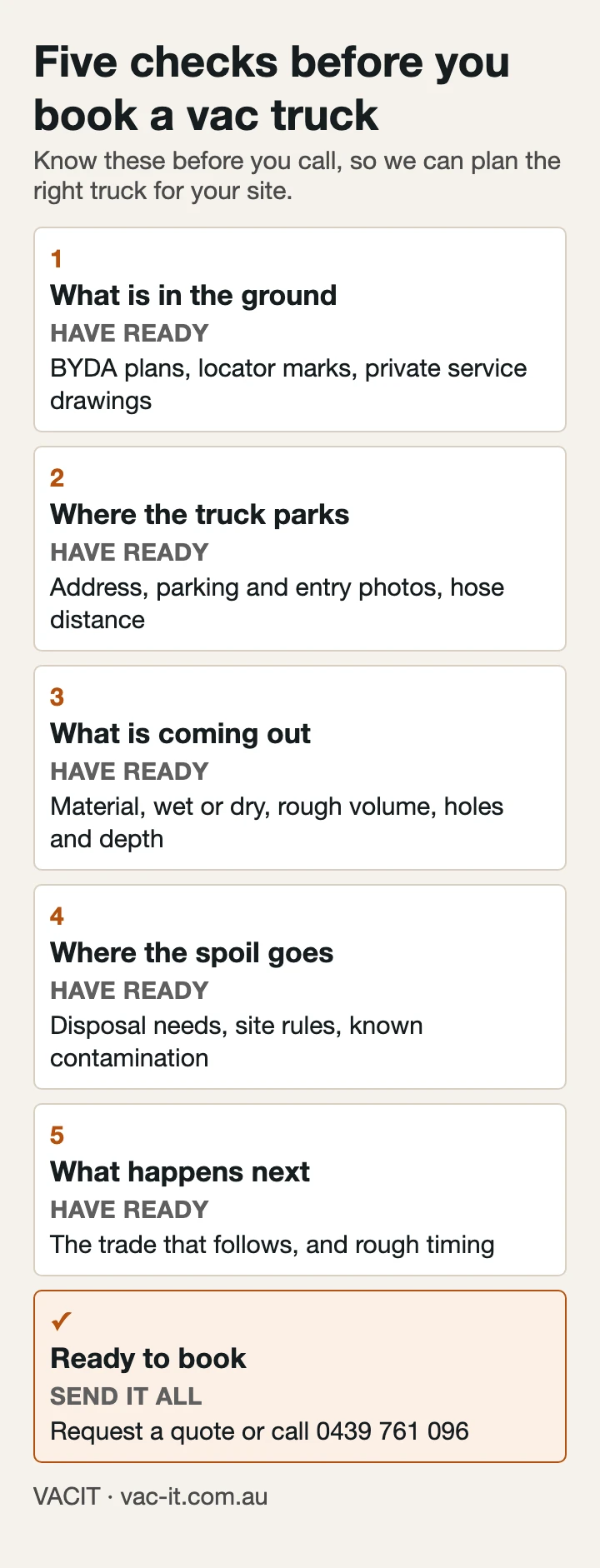
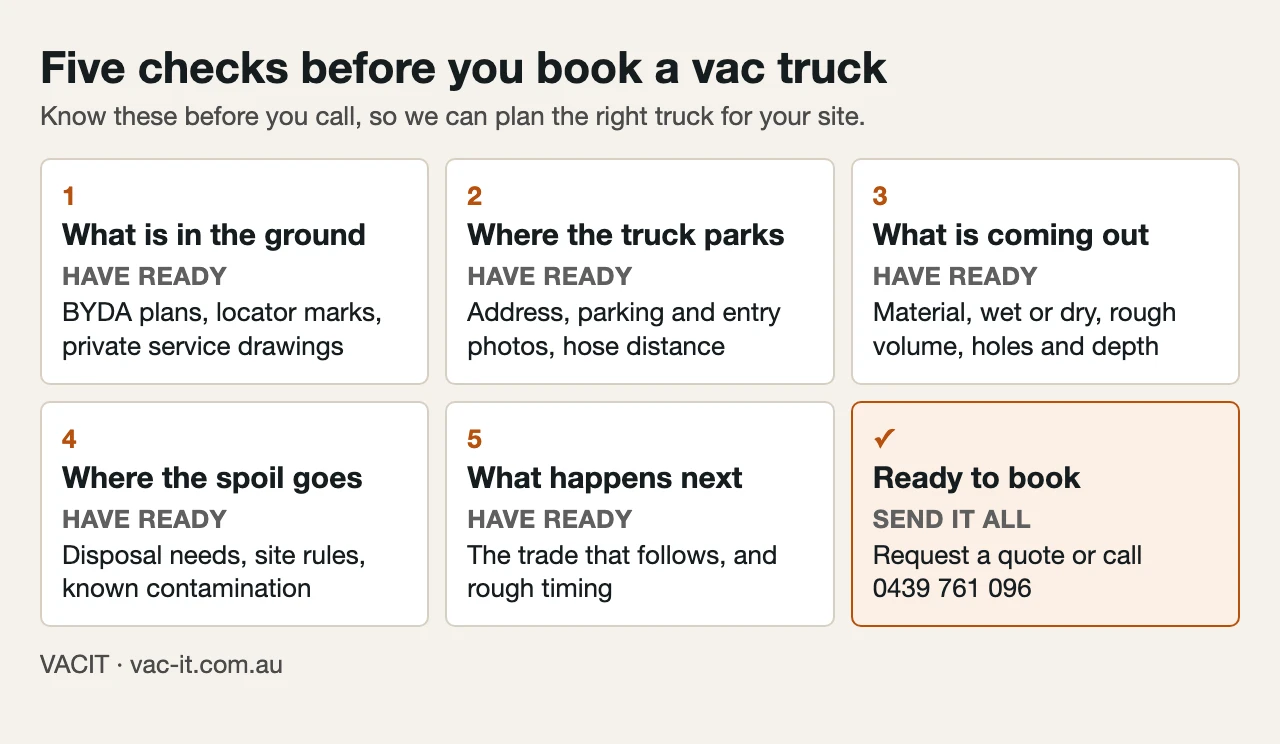
Run through these five checks before you book. You don't need every answer to be perfect. You do need to know which ones are still open.
| Check | Have this ready | If you don't have it yet |
|---|---|---|
| What is in the ground | BYDA plans, locator marks, any drawings of private services | Book locating first, or ask about both in the same enquiry |
| Where the truck parks | Site address, entry and parking photos, estimated hose distance | Send photos of the entry and work area, and any access limits |
| What is coming out | Material type, wet or dry, rough volume, pit or tank size, hole count and depth | Send photos and your best estimate, marked as a guess |
| Where the spoil goes | Disposal needs, site rules, anything known about contamination | Say what is unknown, and raise possible contamination early |
| What happens next | The trade or activity that follows, and its timing | Tell us the likely timing, even if it isn't fixed |
When the job can't wait
Some jobs won't wait for every box to be ticked. A blocked pit backing up in a storm, or a sump (a collection pit) about to overflow, needs a truck now.
For urgent work, call 0439 761 096. Have the site address ready, what is happening, where the truck can park and any hazards you know about. Send photos as soon as you can. We can sort out the rest with you as the job goes.
What we need from you
When the five checks are done, a quote request is quick. Send what you have, including the gaps, with photos of the work and the access.
We use those details to match the truck and crew to the job. You can send them through REQUEST A QUOTE, or call us on 0439 761 096 to talk it through.
General information only
This article is general information, not legal, engineering or safety advice. Check current requirements with WorkSafe Queensland, your local council and the Queensland Government's waste pages. Sources were checked on 18 November 2026, using a September 2026 copy of the code.
Trucks and crews across South East Queensland
Ready to send the job details?
Send what you have, including the gaps. Photos of the work and the access help us match the truck and crew.
VACIT ON GOOGLEFrequently asked questions
What is a vac truck used for?
A vac truck is used to dig carefully around buried pipes and cables, and to load wet material out of pits, tanks and drains. On digging work, water loosens the soil and the vacuum lifts the slurry into the tank, so no bucket comes near the services.
How much does a vac truck hold?
It depends on the truck. VACIT's nine trucks have debris tanks from 5,000 to 10,000 litres. On digging work, the water used to loosen the soil goes into the tank too. So a truck removes less soil than its tank size before it needs emptying.
How far can a vac truck reach?
Reach depends on the truck, the hose setup, how far down or up the material sits, and what the material is. That's why we ask how far the truck can park from the work. Send the estimated hose distance and a few photos of the access, and we'll match the setup to your site.
What is another name for a vac truck?
On site you'll hear sucker truck, vacuum truck, vac ex truck or hydro vac truck. Each is a truck with a vacuum system, a sealed tank and a suction hose. Set-ups differ between trucks, but the names cover the same kind of machine.
Do I need BYDA plans before a vac truck comes?
For work in the ground, yes, plans should come first. Queensland's excavation code says information about underground services may not be accurate, so it expects the ground to be checked before digging. The usual order is plans, then locating, then careful exposure, often with a vac truck.
Related Posts
Vacuum Excavation Cost: The Hours You Pay For Around the Digging
Vacuum excavation cost depends on more than the hourly rate: travel, set-up, waiting, dump runs and return visits. What to send for an accurate quote.
Excavation Work Code of Practice: Using the Queensland Version
Which excavation work code of practice applies on a Queensland site, what it asks before digging near underground services, and what to keep on file.
Is Dial Before You Dig Free? What BYDA Plans Cover
Lodging a Before You Dig Australia enquiry is free. Here is what the free plans cover, what they leave out, and what a Queensland site still needs.
Vacuum Excavation vs Hydro Excavation
Hydro excavation is a type of vacuum excavation, not a rival method. Here is what the terms actually mean, what Queensland rules expect first, and what to send with an enquiry.