
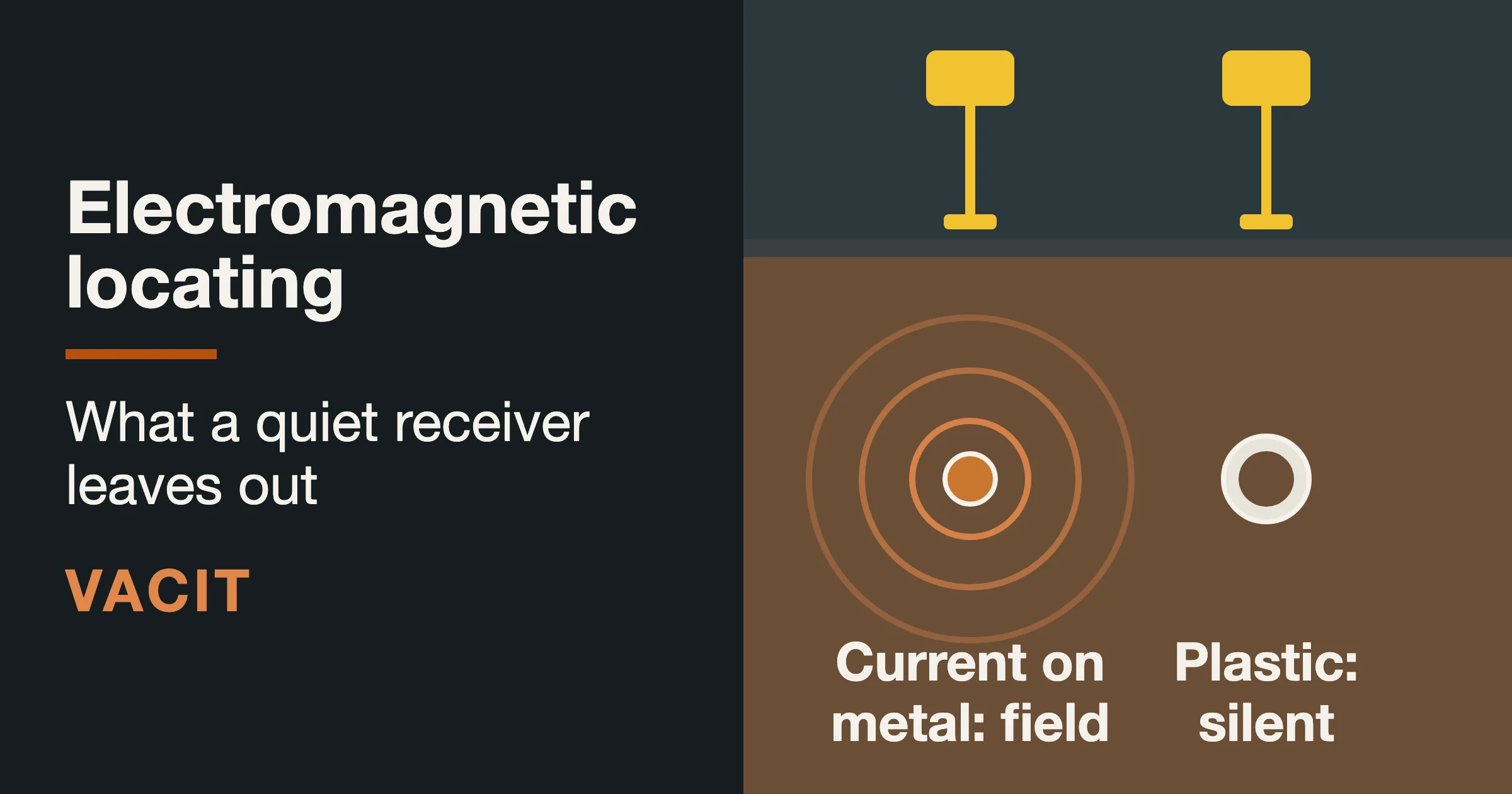
A locator has walked your trench line, the receiver stayed quiet, and the crew wants to start digging. Before anyone takes that as clear ground, it helps to know what the receiver was listening for. Electromagnetic locating is fast and very good at finding metal and traced services. It also has blind spots that a quiet screen won't tell you about.
The short answer
Electromagnetic locating finds the magnetic field made by electrical current flowing on a buried conductor. It does not find the pipe or cable itself.
That means a service with no current on it, or no metal in it, can stay silent. Plastic, concrete and clay pipes, and fibre optic cable without a tracer wire, are the common examples.
A quiet receiver tells you no field was picked up with that setup. It does not tell you the ground is empty.
Key takeaways
- An electromagnetic (EM) locator reads a magnetic field from current on a conductor, not the service itself.
- Plastic, concrete, clay and fibre services can't be traced by current flow. A tracer wire, or a sonde pushed through the pipe, gives the receiver something to follow.
- A passive sweep only hears signals already on a line. A power cable with its load switched off can give no signal and still be live.
- The depth on the screen is an estimate. One manufacturer warns never to use it to set digging depth.
- A 2023 WorkSafe Queensland incident alert says electronic locating gives approximate locations, and potholing by non-mechanical digging proves the exact position.
What the receiver is listening for
An EM locator has two parts: a receiver you walk over the ground, and often a transmitter that puts a signal onto a line. When current flows along a buried conductor, it makes a magnetic field around it. The receiver picks up that field and shows where it's strongest.
Locator manufacturer Radiodetection puts it plainly in its theory guide to cable and pipe location. It says EM locators "do not locate pipes and cables; they locate alternating magnetic fields."
That one line explains most of what follows. If a service carries no current, or has no metal to carry it, there's no field to find. The useful part is knowing when the receiver has nothing to hear.
Passive sweeps and active traces
Locators work in two broad modes, and they answer different questions.
Passive locating. The receiver listens for signals already on buried lines. These include current in a loaded power cable, or radio signals picked up by long metal runs. It needs no transmitter, so it's a quick first sweep. The same guide notes passive signals let conductors "be located, but not identified", because the same signals can sit on any metal line.
Active locating. A transmitter puts a known signal onto the target line, by clipping on to it, clamping around it or inducing it from above. The receiver then follows that signal. This is how a locator can identify and trace one particular line among several.
The catch with passive mode is that it depends on current already flowing. The US Federal Highway Administration has a summary of cable and pipe locators. It says passive detection is not possible for unpowered lines "such as water or sewer lines, generally, and power lines when current is not flowing."
That last point matters on site. Radiodetection notes that a high voltage cable can be live with its load switched off. In that case there is "no detectable power signal, but it remains a potential danger." Silence on a power cable is not proof it's dead.
The services that stay quiet
Some services give an EM receiver very little or nothing to work with. The table below shows the usual pattern. It comes from the FHWA summary and Radiodetection's guide to tracing non-metallic pipes.
| Service material | Can EM trace it without a tracer or sonde? | What gives the receiver a signal |
|---|---|---|
| Steel, iron or copper pipe | Yes, with an active signal; response is usually strong | A transmitter connected, clamped or induced on to the line |
| Power cable | Yes; passively only while current flows | Load current, or an active signal applied to the cable |
| Plastic or PVC pipe, including poly | No | A tracer wire laid with it, or a sonde or wire pushed through it |
| Concrete, clay or other non-metallic pipe | No | A tracer wire laid with it, or a sonde or wire pushed through it from an access point |
| Fibre optic cable | No | A metal tracer wire laid with it |
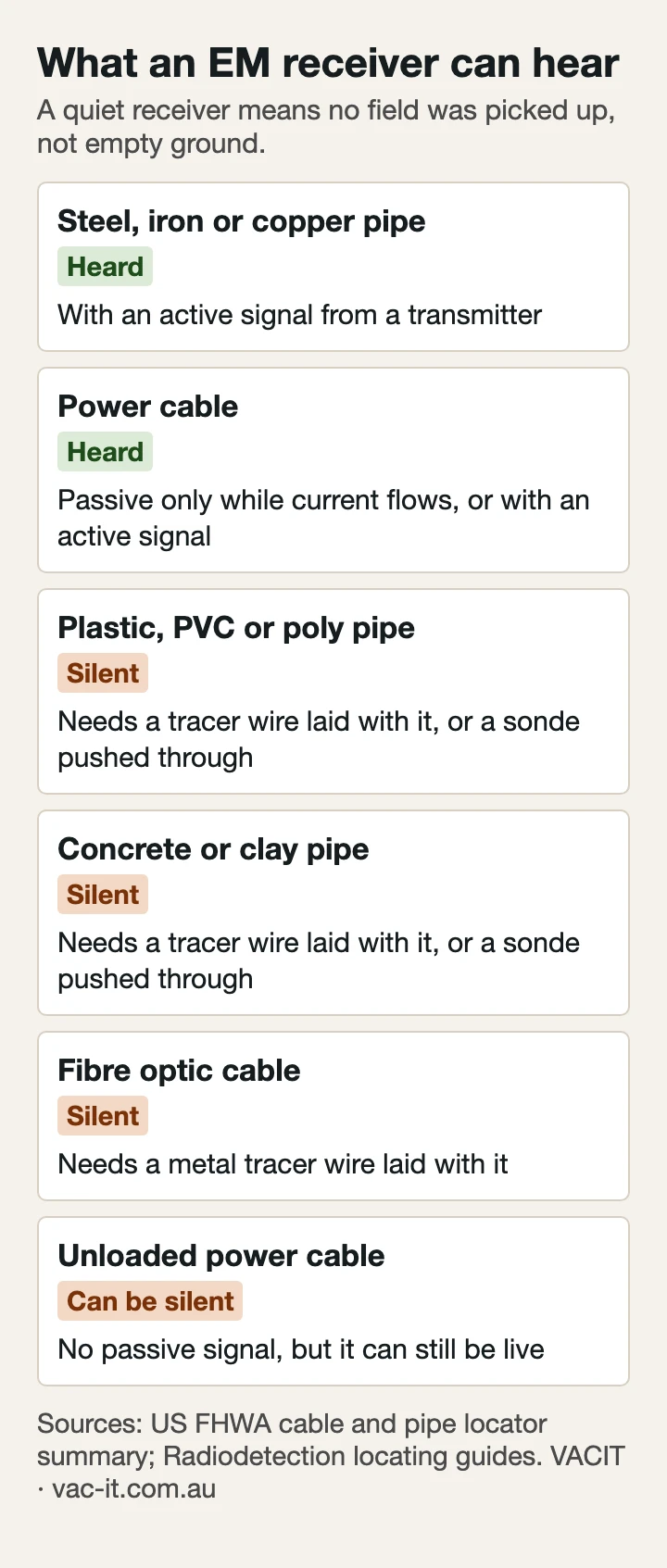
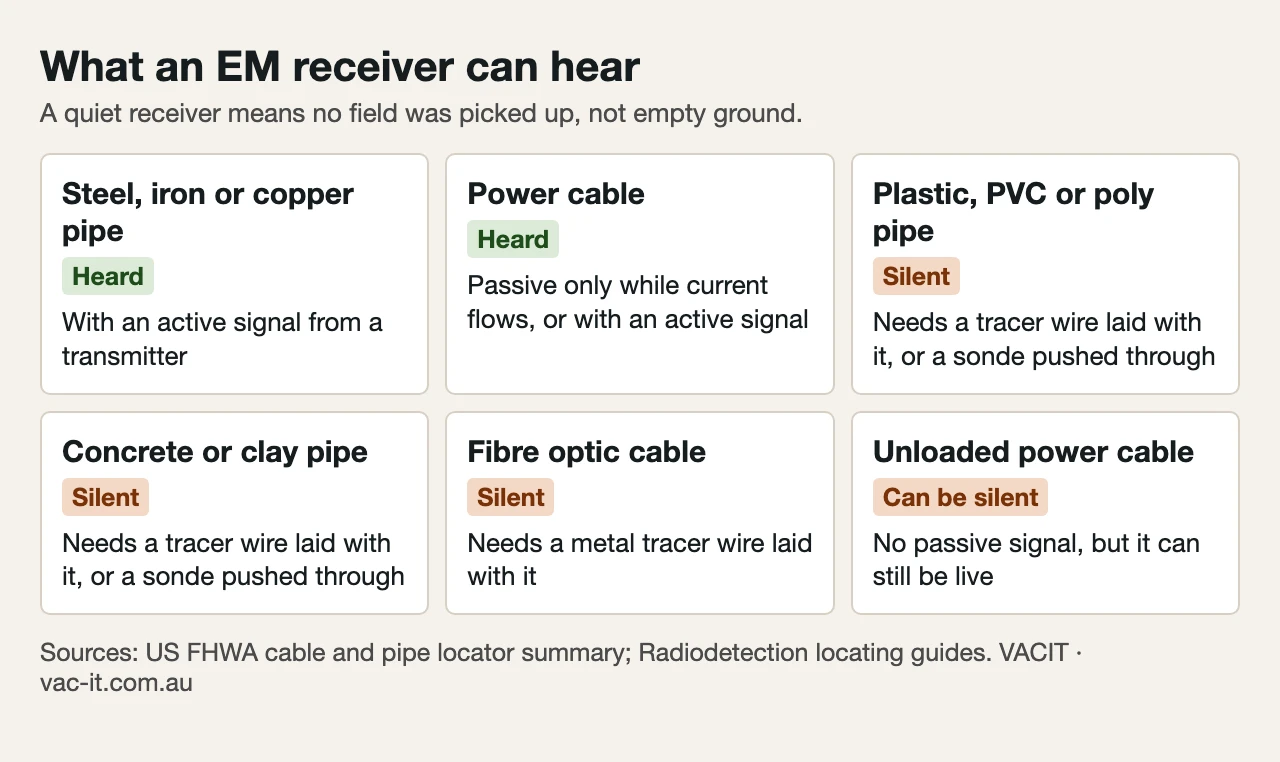
On plastic and concrete, Radiodetection is direct: "there is no way of detecting and tracing them electromagnetically by current flow, unless a tracer wire is inserted or laid near to the line." A sonde is a small battery transmitter pushed through a pipe on rods, so the receiver can follow it from above. That only works where someone can get into the pipe.
Tracer wires help, but only where they were laid, connected and left unbroken. Treat any plastic service as quiet until something proves otherwise. Where there's no signal to follow, ground penetrating radar can help.
Queensland adds a warning of its own. A 2023 WorkSafe Queensland incident alert describes a person who unearthed a black poly pipe, believed to be the water pipe that needed repair, and cut into it. Early enquiries indicated the shears appear to have contacted an energised cable inside. The alert says cables can sit inside "concrete, steel, or plastic pipe", and warns against assumptions about unknown poly piping.
Why the depth on the screen is an estimate
Many locators show a depth figure when held correctly over a traced line. It's useful, but it's a calculation from the shape of the field, not a measurement of the pipe.
Radiodetection's support article on depth and current readings says depth accuracy "is meant as a guide only. Never use the depth measurement to define mechanical digging depths." The reading is to the centre of the line, not its top.
Several things push that estimate off:
Nearby lines. Another line carrying signal within 1 to 2 metres is, in the manufacturer's depth-checking guide, the most common source of depth error. It says this can often introduce ±50% error.
Bends and tees. The field bends with the line. The same support article advises measuring at least 5 metres from a bend.
Passive signals. Passive signals can sit on more than one line, so they're less suited to depth readings.
Ground conditions. The FHWA notes locating depth "reduces considerably in dry sand and alkaline and high iron-content soils".
Ground levels change too. The WorkSafe Queensland alert warns that cables "may not be at the original depth because of changes in ground levels". So a depth on an old plan and a depth on the screen can both be wrong.
What Queensland guidance says
Before excavation starts, the person managing the workplace has to "obtain current underground essential services information". That duty sits in the Work Health and Safety Regulation 2011, section 304, summarised on WorkSafe Queensland's excavations page. In practice, that starts with Before You Dig Australia (BYDA) plans. Our guide to what happens after a BYDA request covers the plans step.
On locating itself, the 2023 WorkSafe Queensland alert lists a control measure: "Use electronic locating instruments to establish approximate locations." It then adds: "plans and/or electronic service location, cannot be relied upon for physical service locations." It says non-mechanical excavation must occur to find exact locations.
It also says how: "Visually locate cables by potholing", using hydrovac or non-conductive hand tools, "to prove the exact location." Our guide to how the Queensland excavation code applies on site covers the wider duties.
Covering what the receiver cannot hear
None of this means EM locating isn't worth doing. It's quick, it identifies and traces metal and traced lines well, and it can find traceable services that aren't on the plans. The point is to pair it with methods that cover its gaps.
Records first. Plans and site records tell you what to look for, and which services are plastic or fibre and need another method.
Ground penetrating radar (GPR). Radar sends a pulse into the ground and reads what comes back. It can help with items that won't carry an EM signal, such as non-conductive pipe. Results are interpreted, and radar doesn't detect everything. VACIT uses an IDS GeoRadar Stream C 3D radar array for its ground penetrating radar work.
Exposure. Careful vacuum or hydro excavation, often called potholing, lets everyone see a service at that point. It confirms the service you exposed, not everything else in the ground. Our guide to potholing before excavation explains how it's done.
On a VACIT locate, we work from the records and plans and trace services on site with electromagnetic equipment. We bring in radar where the records and the tracing leave gaps. Our locating crews mark what they find on the ground. Where a service needs to be seen, the locating and the potholing can be booked together. How VACIT's underground service locating works explains the full process, and our utility mapping page explains how records, tracing and radar come together.
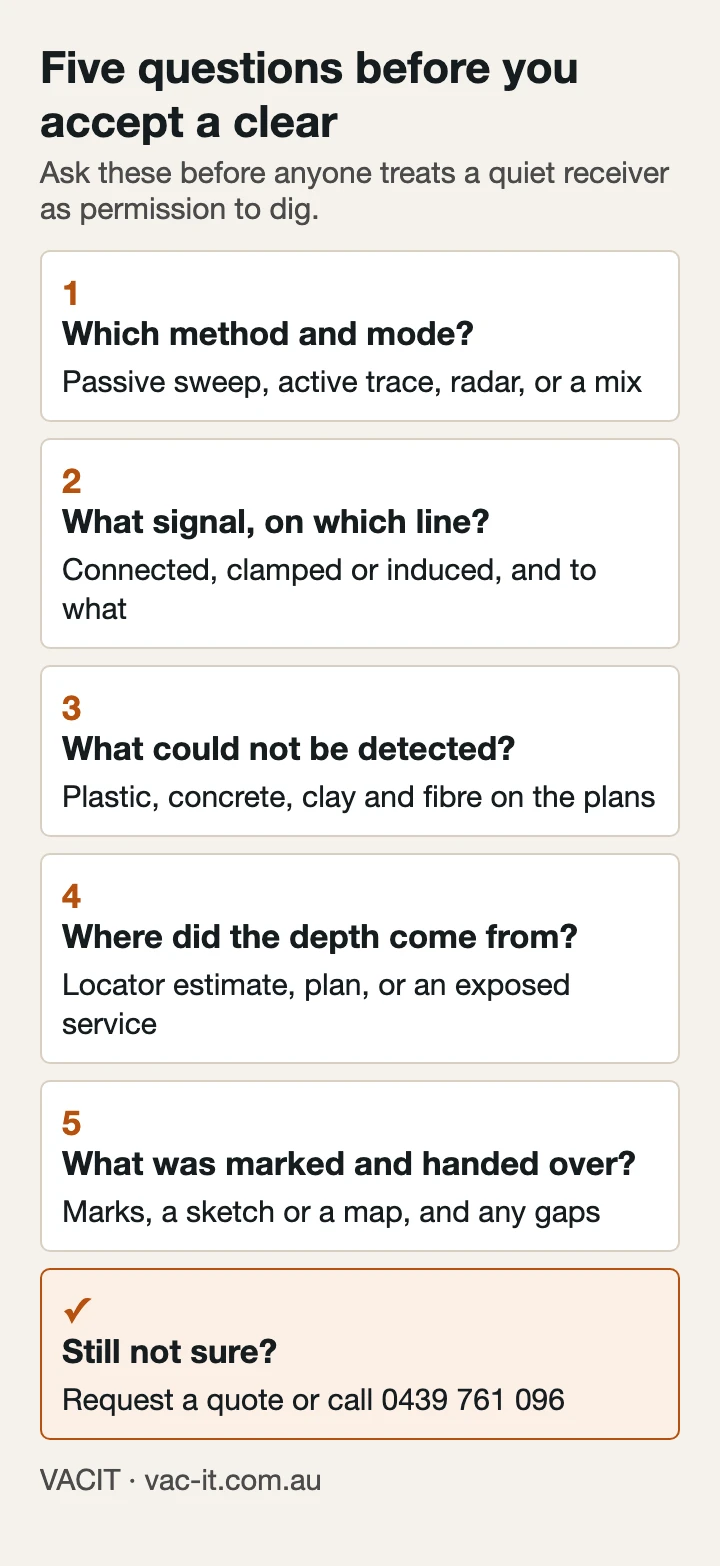
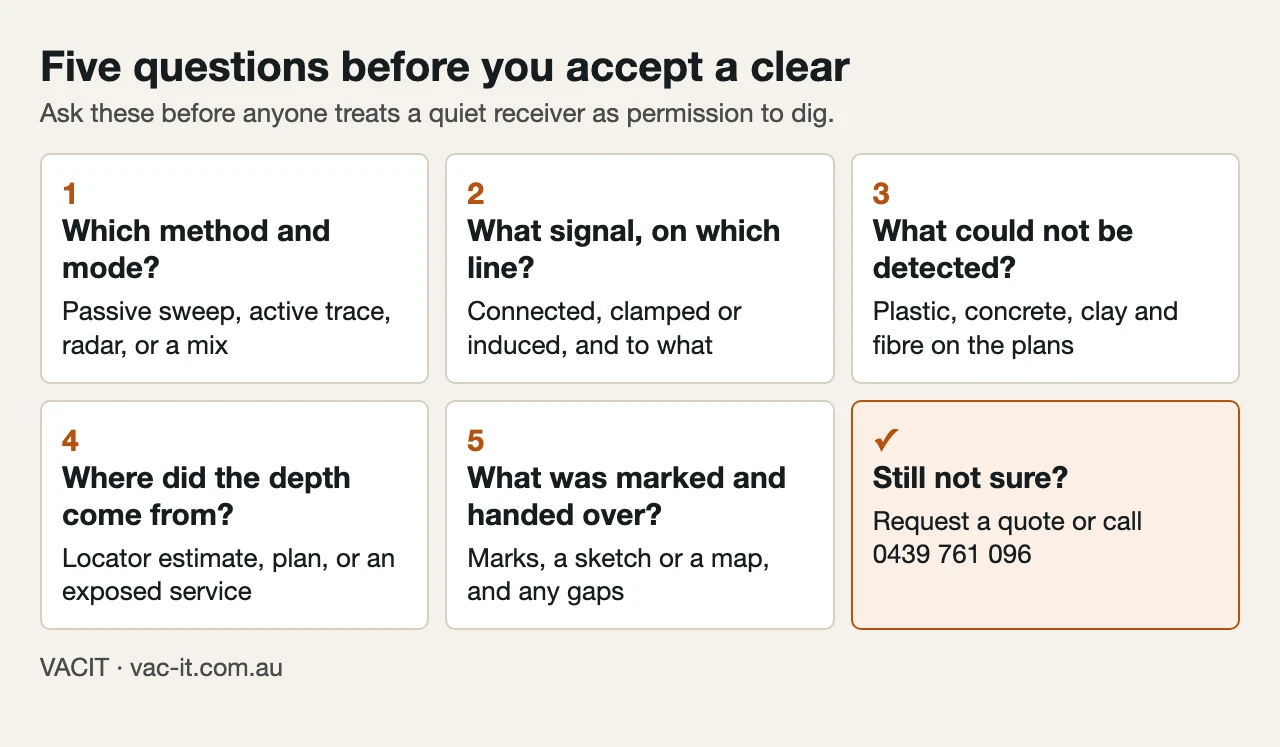
Five questions before you accept a clear
A "clear" here means the all-clear to dig. Use these questions before anyone treats a quiet receiver as that permission.
1. Which method and mode were used? A passive sweep, an active trace, radar, or a mix. A passive sweep alone can miss unloaded cables and every non-metallic service.
2. What signal was put on which line, and how? Ask whether the transmitter was connected or clamped to a known line, or induced from above. Radiodetection's depth and current article advises against induction for depth readings because it distorts the signal.
3. What could not be detected? Ask which services on the plans are plastic, concrete, clay or fibre, and how each was checked.
4. Where did the depth come from? A locator estimate, a plan, or an exposed service. Only exposure shows where the service actually sits.
5. What was marked and handed over? Marks on the ground, a sketch or a mapped record, and a note of any areas that couldn't be checked.
What to send us
If your corridor needs locating, or a "nothing found" result needs a second look, send us what you have. Include the site address, your BYDA plans, the work area, the services you expect, and the trade or activity booked after the locate.
Photos or a marked-up plan of the area help us plan the right mix of tracing, radar and exposure. You can send it all through REQUEST A QUOTE, or call us on 0439 761 096 to talk it through.
General information only
This article is general information, not legal, engineering or safety advice. Check current requirements with WorkSafe Queensland, your asset owners and your site's safe work procedures. Sources were checked on 24 November 2026.
Locating across South East Queensland
Need a corridor located, or a clear checked?
Send your plans, the work area and what follows the locate. We plan the tracing, radar and any exposure around it.
VACIT ON GOOGLEFrequently asked questions
Can a cable locator find plastic pipe?
Not on its own. An electromagnetic locator follows current on a conductor, and plastic carries none. A plastic pipe can be traced if a tracer wire was laid with it, or if a sonde or wire is pushed through it. Otherwise radar or careful exposure is needed.
What is the difference between passive and active locating?
Passive locating listens for signals already on buried lines, such as current in a loaded power cable. Active locating uses a transmitter to put a known signal on a chosen line, so the receiver can identify and follow that line. Passive mode can miss unpowered water and sewer lines and unloaded power cables.
How accurate is a locator depth reading?
It's an estimate, not a measurement. One manufacturer says depth readings are a guide only and should never set mechanical digging depth. Nearby lines, bends, passive signals and some soils all push the figure off. Exposing the service is the way to see its real depth.
What is the hardest utility to locate?
Services with no metal and no tracer are the hardest for electromagnetic locating: plastic and poly pipe, concrete and clay pipe, and fibre optic cable. Power cables with no load can also be quiet in a passive sweep. These usually need records, radar and exposure.
Does a quiet receiver mean it's safe to dig?
No. It means no field was picked up with that method and setup. A 2023 WorkSafe Queensland incident alert says electronic locating gives approximate locations and non-mechanical excavation, such as hydrovac or non-conductive hand tools, proves the exact position.
Related Posts
What Is a Vac Truck? Five Checks Before You Book One
What is a vac truck? A truck with a vacuum, a debris tank and a suction hose, run by a crew. What it does, and five checks before you book one.
Vacuum Excavation Cost: The Hours You Pay For Around the Digging
Vacuum excavation cost depends on more than the hourly rate: travel, set-up, waiting, dump runs and return visits. What to send for an accurate quote.
Excavation Work Code of Practice: Using the Queensland Version
Which excavation work code of practice applies on a Queensland site, what it asks before digging near underground services, and what to keep on file.
Is Dial Before You Dig Free? What BYDA Plans Cover
Lodging a Before You Dig Australia enquiry is free. Here is what the free plans cover, what they leave out, and what a Queensland site still needs.